How the Bull, the Ram, and the Fish Tell the Story of God Maturing Humanity, and What it Means for Christian Living Today
By: Daniel S. and Brian P. | 5 min read
(Disclaimer: On this blog, I may feature a select number of partners and companies that have products that can help my audience. If you happen to make a purchase through my partner affiliate links, I may earn a commission from them, at no extra cost to you).
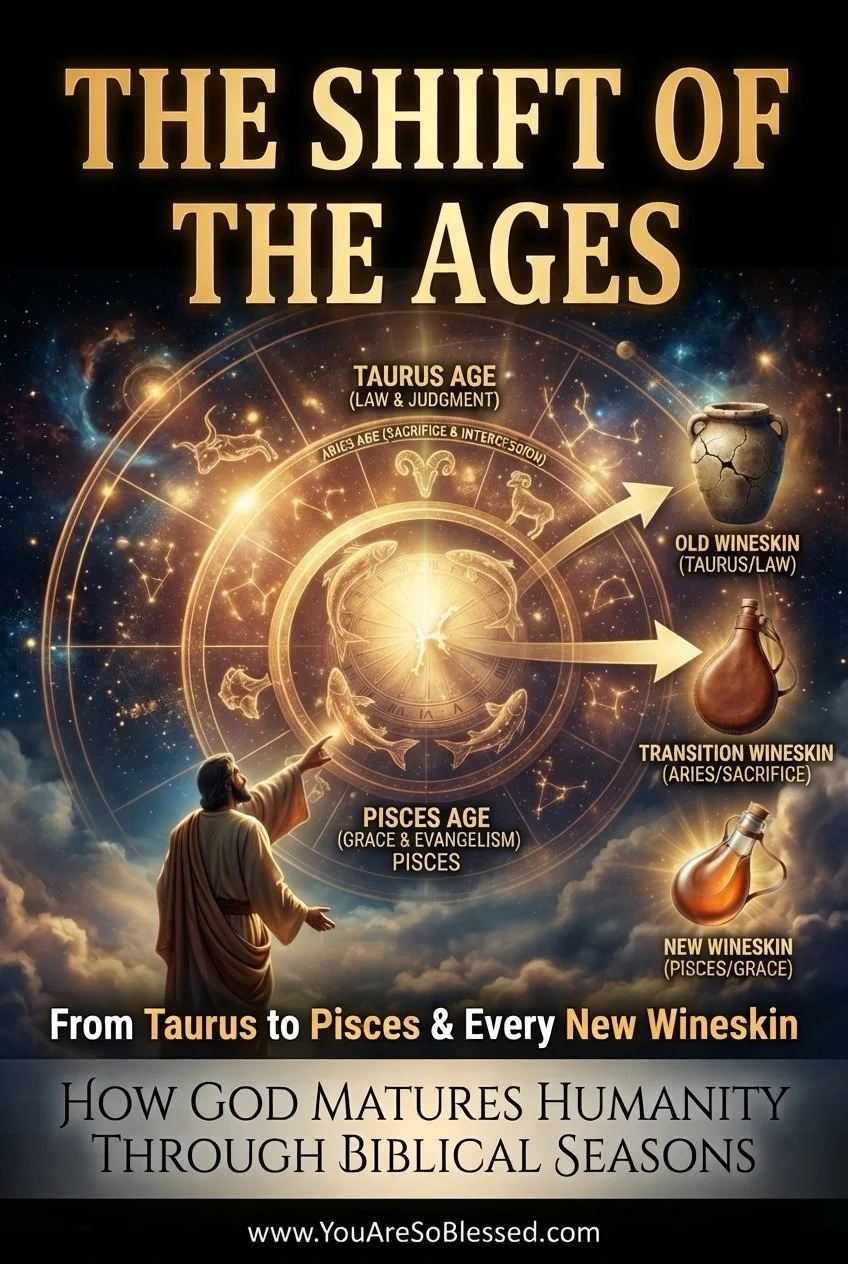
Image created with Gemini
The Shift of the Ages
By now, we know it’s God who set times and seasons in place from the very beginning, and we now understand what the disciples were really asking when they said "the end of the age." (Read that post here). If an age is an era, a natural question follows: what have those eras actually looked like?
The picture that emerges is a story of God patiently maturing humanity, one age at a time, back toward the oneness we had in the garden. Each shift brought a new understanding of who God is, who we are, and the nature of reality itself. Those shifts are also what prepare us to understand the one we're entering now.
A quick note before we begin: the dates tied to these ages are approximate, and the exact boundaries are debated. Each age lasts around 2,000 to 2,100 years, and the constellations are so large that the edges blur and overlap. This is why some believe the world is ending, while others perceive it as a new era is beginning. What matters is the pattern, and how clearly it lines up with the biblical story.
The Age of Taurus: The Bull and the Golden Calf
Taurus, the age of the bull, is placed at roughly 4,300 to 2,150 BC. It overlaps with the rise of the great early civilizations: Mesopotamia, Babylon, ancient Egypt. Bull imagery shows up across many of these cultures, and with it came widespread idol worship.
It was also a low point in human consciousness. In this era, cultures offered their own children to the sky gods, to Molech and Baal. This is the world Abraham lived in. When God asked him to take Isaac up the mountain (Genesis 22), it was a command that fit what everyone around him was already doing. Then, at the last moment, God stopped him and provided an animal instead. Human sacrifice was being retired.
The Israelites show how hard it is to leave an age behind. As Moses was on the mountain receiving the law, which was a step up into greater revelation, what did the people make at the bottom? A golden calf (Exodus 32). The age of Taurus had passed, but their minds were still living in it. Moses destroyed it, and the old religious order came down.
The Age of Aries: The Ram and the Sacrificial System
Aries, the ram, runs from roughly 2,150 BC to the time of Jesus. This is the age of the law, the attempt to overcome sin and death through a system.
Look at what fills the Old Testament in this era:
Sheep, lambs, and rams at the center of Israel's sacrifices
The Passover, with the blood of the lamb on the doorposts
The tabernacle and the priesthood, with everyone in their role
The shofar, the ram's horn, sounding across the camp
Notice the movement. God moved humanity from sacrificing its children to sacrificing animals. That was a major step upward, and for its time, it was the highest truth people could receive. The ram was also quietly pointing forward. It prophesied the final sacrifice, the Lamb who would be "slain before the foundation of the world."
The Age of Pisces: The Fish and the Church Age
Then, at roughly year one, Jesus steps onto the scene. Pisces, the fish, is the age of the Church, and the fish is everywhere you look:
Jesus says, "Follow me, and I will make you fishers of men" (Matthew 4:19).
He multiplies loaves and fish to feed the crowds.
The nets are so full of fish they begin to break (John 21).
A coin is found in a fish's mouth to pay the temple tax (Matthew 17:27).
After the resurrection, Jesus cooks fish for His disciples on the beach.
The early believers used the fish as their secret symbol.
Jesus said He had not come to abolish the law but to fulfill it (Matthew 5:17). The whole sacrificial system of the Aries age was being completed in Him. That is why John the Baptist, standing at the doorway between two ages, could point at a man and say, "Behold, the Lamb of God, who takes away the sin of the world" (John 1:29). We'll look at that moment more closely in the next post.
The Trap of Old Wineskins
Here is where this becomes more than history. The Pharisees and Sadducees were people of deep devotion. They had built great doctrines on the revelation they'd received in the age of Aries, and rightly so. It was the highest truth available to them. But it was now a previous dispensation of time. That era was ending and they failed to perceive it.
So, when Jesus arrived, their framework had no room for Him. They said they knew Moses was from God, but they didn't know where this man came from (John 9:29). They called Him Beelzebub and demon-possessed! Can you imagine the “religious experts” being so blind that they basically called the Son of God, the devil! Jesus said that the traditions of men can make the ever-expanding word of God null and void (Mark 7:13) and the Pharisees and Sadducees seemed to uphold their traditions above knowing God’s ways.
This is the principle of the wineskin. Jesus said, "No one puts new wine into old wineskins. Otherwise, the wine will burst the skins, and the wine will be lost" (Mark 2:22). In other words, new content needs a new context. When people don't have the new frame, they tend to label what they don't understand as "new age" or "demonic."
It's not entirely fair to them, either. Nobody was announcing on the news that God had just moved the world into a new age. Religion tends to become even more religious, and the culture around us becomes more fearful, and none of that points us toward what God is doing next.
Why This Matters for You
If the ages have shifted before, and each time the people most devoted to the previous age struggled to recognize the next one, then this is worth asking ourselves honestly:
Where am I still living in a previous age? Like the Israelites with the golden calf, we can carry old patterns long after God has moved on.
Am I confusing familiarity with truth? The framework that carried us this far may be a good wineskin that now needs to expand.
Can I honor the past and still welcome the new? We honor the revivals, the movements, and the teachers who brought us here. Jesus said He came to fulfill the old, not despise it and we must be able to perceive when the Lord is shifting things, so we “follow the cloud by day” and “the pillar by night” (Exodus 13:21-22), not being left behind.
God has always been moving humanity back toward oneness with Him, one age at a time. If you're feeling the stretch of a new season, you're in good company. You may be standing exactly where the early disciples stood.
A question to reflect on this week: Which of my beliefs about God am I holding because they're true, and which because they're familiar?
In the next post, we'll step into the story of the one who stood in the gap between two ages: John the Baptist, and the forerunner calling.
Ready to go deeper?
If your heart is hungry for the deeper things of God, you don’t have to walk this out alone. Inner Dimensions is our private community for believers who are awakening to the Kingdom Age. Together we learn, practice, and grow in the finished work, live, alongside like-minded believers. Members also receive the Awakening to the Kingdom Age E-book and Video Course bundle for FREE.
A gentle note: Inner Dimensions is for people who are truly open-hearted and unafraid of exploring more of God. If that’s you, [click here to learn more and join]. If you’re not sure the community is for you, or you’re not quite ready, that’s perfectly okay.
You can still explore this teaching at your own pace:
[The Bundle (E-book + Video Course)], available at a discounted price compared to buying each separately
We sure hope that our blog posts are insightful and gently renewing your mind, by the Spirit of the Lord. We’ve love to hear your thoughts - leave a comment!
Check out the Full line of Digital Products Here