Why "Fear Pretending to be Wisdom" Can Look Spiritual, and How
Fruit, Peace, and Personal Intimacy with God Reveal the Truth
By: Daniel S. and Brian P. | 6 min read
(Disclaimer: On this blog, I may feature a select number of partners and companies that have products that can help my audience. If you happen to make a purchase through my partner affiliate links, I may earn a commission from them, at no extra cost to you).
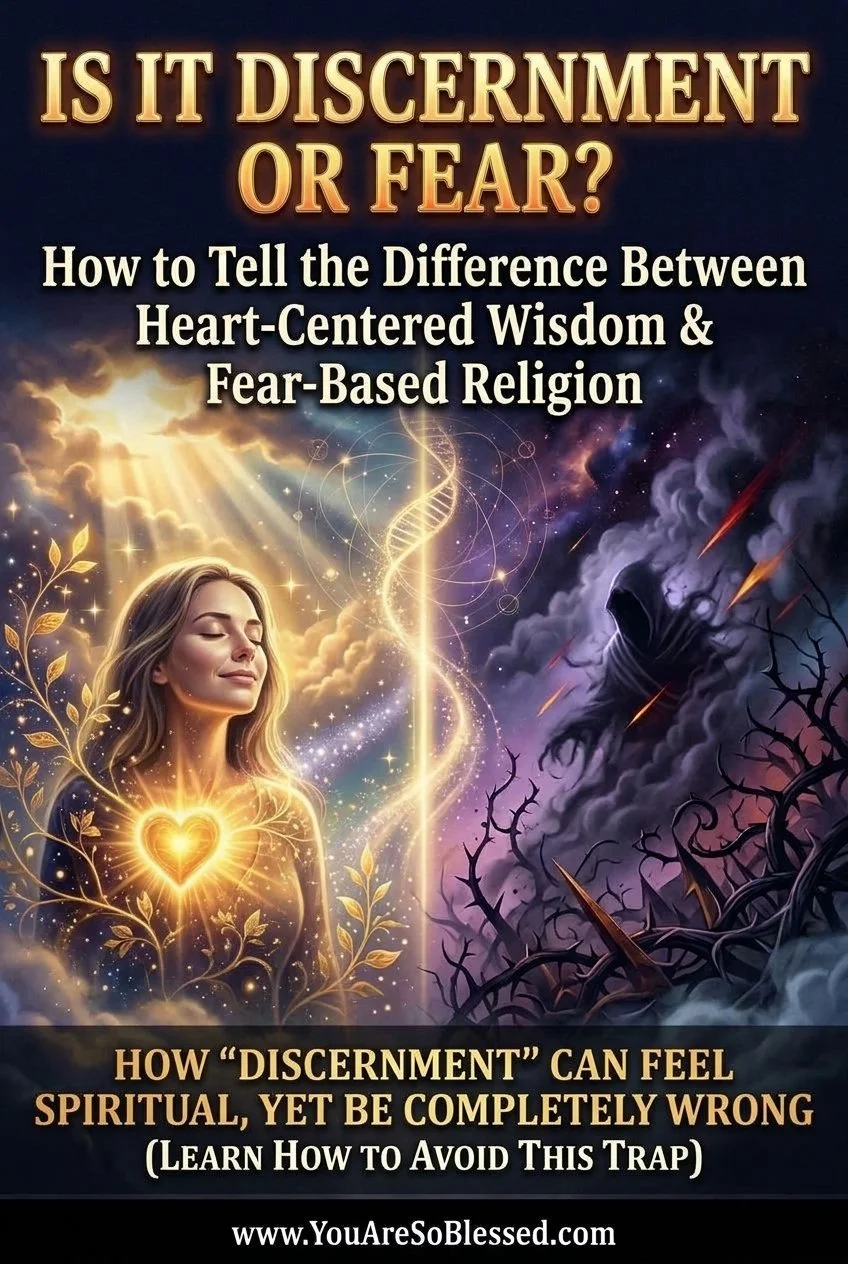
Image created with Gemini
"Something Feels Off": Is That Discernment?
You're listening to a teaching, and something in you tightens. A warning goes off: This isn't right. Be careful. So, you pull back, and you feel proud of yourself for being “discerning.”
But what if that tightening wasn't discernment at all? What if it was fear dressed up as wisdom? Yikes.
This question matters more than almost any other in a season of spiritual change. Discernment is a gift from God, and we need it, but fear is very good at borrowing its voice. The two can even feel almost identical from the inside. Learning to tell them apart can protect your peace and your heart, and keep you from closing the door on something God is trying to give you.
The Pharisees Had “Discernment” Too
Consider the Pharisees. They were deeply serious about protecting what they believed was true. When Jesus came, they used their “discernment” on Him. They concluded that He was demon-possessed, and called Him Beelzebub (Matthew 12:24). They felt justified. They believed they were defending God.
And they were wrong.
That should give all of us pause. Strong conviction and sincere devotion aren't proof of accurate discernment. The Pharisees were certain, and they were certain about the wrong thing.
The Question Underneath Every Discernment
If discernment is the ability to tell whether something lines up with the character and nature of God, then a more basic question sits beneath it: Do I have an accurate view of God?
Think about it. If your picture of God is an angry, distant, wrathful Father, then your “discernment” will be built on that picture. You'll look at anything unfamiliar through that lens, and you'll feel justified in telling people they're wrong, they're deceived, or they're headed for trouble. You might even believe you're being loving.
That is why, in the old wineskin, a church-age style of “discernment” can end up being fear-based trauma masquerading as truth. It looks like wisdom, but its root is fear.
Let’s look at several ways to tell the difference.
Check the Root: Fear or Love?
One of the simplest tests is to ask what's behind the reaction.
Fear-based discernment is often about protecting yourself. What if I'm deceived? What if I get it wrong? What if I'm contaminated? If you're worried about yourself in it, that is a good signal that you're in fear-based consciousness.
Heart-centered discernment is rooted in love and care. You can see that someone might be going down a wrong path, and you feel compassion for them, but nothing in you is threatened. There are no hooks in you. That is a sign you likely have the heart of God around it.
In 1 John 4:18 says, "There is no fear in love, but perfect love casts out fear." If a warning comes with panic, anxiety, or the urge to condemn, it's worth pausing before treating it as the voice of the Spirit.

YOUR 5-DAY JOURNEY
to a RENEWED MIND!
Mini E-Book: This quick-start guide will jump-start your efforts in re-training your mind, guided by God's Truth & practical methods that anyone can do. You don't have to walk this path alone. As Holy Spirit has led me in writing this guide, I will lead you for the next 5 days. Learn More Here
Look in the Mirror: What Fruit Is It Producing?
Jesus said, "You will recognize them by their fruits" (Matthew 7:16). That principle works for ideas and for ourselves.
It's easy to examine other people's fruit. It's harder to look at our own. So here are some honest questions to ask about your own "discernment":
Is it producing peace, joy, and freedom, or condemnation, anxiety, and judgment?
How is my peace on an ordinary day?
How am I actually living: my health, my relationships, my sense of rest?
Does my discernment make me more loving, or more suspicious?
Galatians 5:22–23 lists the fruit of the Spirit: love, joy, peace, patience, kindness, goodness, faithfulness, gentleness, and self-control. If our "discernment" regularly leaves us without those, it may be worth asking what's really driving it.
"My Spirit Doesn't Agree": A Gentle Caution
You may have heard (or said) "I just don't have peace about that. My spirit doesn't agree." Sometimes that's accurate. The Holy Spirit does speak to us through our inner senses.
However, it helps to be honest about what's behind that feeling. A sense of unease can come from several places. While it might be the Spirit warning you, it also might be old programming. Or, sometimes, it might be God stretching you out of a limited wineskin and into a place where you can finally be free of depression, anxiety, judgment, limitation, or shame. That also feels uncomfortable and isn’t necessarily a sign that something is wrong.
An inner sense is more reliable when it's backed by a real relationship. If we aren't reading the Word, praying, and getting to know God for ourselves, then our "spirit" has little to compare things against. The stronger your own walk with God, the better you can tell His voice from other voices. This is where most Christians discern wrongly. They don’t have their own strong relationship with God and they judge from a tainted perspective or even opinion. The “sense” they get in their spirit, is likely their unsanctified soul.
Go Past Second-Hand Religion
This leads to a key habit: cultivate your own intimacy with the Father.
Many of us rely heavily on sermons and videos, and those can be a blessing, but it's possible to consume a lot of content and have very little personal communion with God. Without it, the Bible teaches that we're easier to mislead and easier to frighten.
Acts 17:11 praises the Bereans because they "received the word with all eagerness, examining the Scriptures daily to see if these things were so." They were open, and they checked. They were neither gullible nor closed-off. That's a healthy model: curious, grounded in Scripture, and leaning on personal relationship with God.
Thessalonians says it simply: "Test everything; hold fast to what is good" (1 Thessalonians 5:21). Testing is good. The difference is whether we test from curiosity and love or from doubt and terror.
Put Unanswered Questions on the Shelf
What do you do with something you aren't sure about?
Most of us already know how to handle this with food. When you eat watermelon, you enjoy the fruit and spit out the seeds. When you eat meat, you enjoy the meat and leave the bones. You don't throw away the whole watermelon because it has seeds, nor throw out the meat because it has bones.
Teachings can be approached the same way. Take what's nourishing, leave what isn't, and put the rest “on the shelf.” You don't have to accept it, and you don't have to condemn it. You hold it loosely and let God build line upon line, precept upon precept (Isaiah 28:10). Often, a piece that made no sense in one season falls into place later. God will take care of confirming the teaching or discounting it, in time, as long as you continue to develop your relationship with God.
It's also normal to find that a teacher or ministry that helped you for a season no longer draws you as much in another spiritual season. It doesn't have to mean something went wrong. It may mean the cloud has moved (or the pillar of fire), and you're following it.
What This Means for You
Check the root. Is this reaction coming from love, or from fear for yourself?
Examine the fruit. Is your discernment leaving you with peace, or with anxiety and judgment?
Build your own relationship with God. Read, pray, and listen for yourself. Let teachers confirm what He is already showing you.
Use the shelf. You can pause without rejecting. Not knowing right away or not understanding immediately is not the same as being deceived.
Keep discernment. None of this means giving up your Bible, common sense or wisdom you’ve learned from God. It means asking God to purify them.
A question to reflect on this week: The last time I felt a strong "no" about something spiritual, was it rooted in love or in fear?
In the next blog post, we'll bring everything together in a guided prayer of surrender, and an invitation to release the old and step into the new. It is our desire to help you grow in your relationship with God through these deep and reflective blog posts.
Ready to go deeper?
If your heart is hungry for the deeper things of God, you don’t have to walk this out alone. Inner Dimensions is our private community for believers who are awakening to the Kingdom Age. Together we learn, practice, and grow in the finished work, live, alongside like-minded believers. Members also receive the Awakening to the Kingdom Age E-book and Video Course bundle for FREE.
A gentle note: Inner Dimensions is for people who are truly open-hearted and unafraid of exploring more of God. If that’s you, [click here to learn more and join]. If you’re not sure the community is for you, or you’re not quite ready, that’s perfectly okay.
You can still explore this teaching at your own pace:
[The Bundle (E-book + Video Course)], available at a discounted price compared to buying each separately
We sure hope that our blog posts are insightful and gently renewing your mind, by the Spirit of the Lord. We’ve love to hear your thoughts - leave a comment!